
Watch Sunset
from Ridgecrest
Open hills, changing light, and a mountain that makes an ordinary afternoon feel far away. Come for the golden hour—and plan your exit as carefully as your view.
By Best of Marin Staff · Reviewed
The reward is the changing light
You do not need to chase the final second
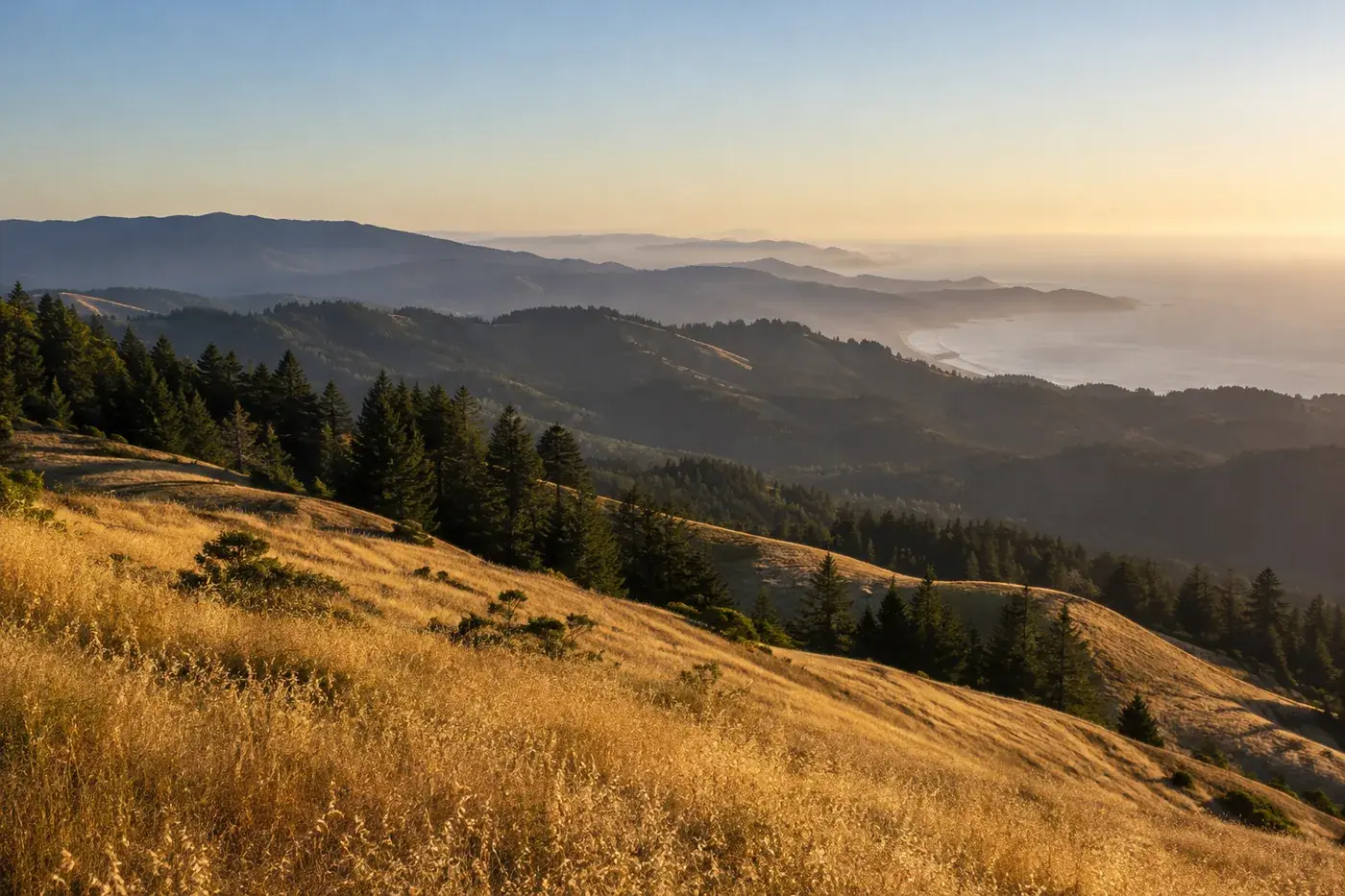
Ridgecrest is at its most memorable when you stop treating sunset as a countdown. Watch the grass change color, the folds of the hills separate into layers, and the shadows stretch across the slopes. On a clear afternoon, the sense of space can be the whole reason to come.
For locals, this is a way to reset without planning a major expedition. For visitors, it is a different Marin from the waterfront towns: exposed, quiet when traffic eases, and shaped by the weather. Give the place a little time instead of racing from one photo stop to another.
The useful version of a “sunset trip” is often a golden-hour visit. You can enjoy warm late-day light and still leave comfortably before closure. A photograph is not worth a locked gate or a hurried drive down a winding road.
Find the right road before you leave
West Ridgecrest is not East Peak
This guide focuses on West Ridgecrest Boulevard on Mount Tam, not the East Ridgecrest drive toward the summit. Rock Spring is a useful orientation point near the Pantoll Road and Ridgecrest junction; consult the official watershed visitor map before choosing an approach.
From the Mill Valley side, a typical approach uses Panoramic Highway and Pantoll Road. Treat that as orientation, not a guarantee that every segment is open on your date. Check current road information before relying on a through-route or a navigation app’s suggested shortcut.
Save your route and map before climbing. Marin Water warns that cell service is limited. Tell someone your plan if traveling alone, and know how you will retrace your route without a live data connection.
Choose a legal stopping place—not just a pretty one
A wide-looking shoulder is not automatically public parking. Follow signs, keep all wheels safely out of the travel lane where parking is permitted, and do not obstruct gates, emergency access, driveways, or turnouts needed for traffic.
If a stopping place is full or the ground is soft, keep moving to a legal alternative or change the outing. Never stop in a lane to unload passengers for a photograph. Do not make a sudden turn or reverse along the road because you spotted a view.
Stay clear of blind bends and avoid crossing unnecessarily. Drivers need to watch for cyclists and pedestrians, especially where low sun makes seeing people harder. The safest view may be the one you enjoy briefly rather than the one you imagined in advance.
Build the afternoon around your exit time
Work backward from closing
Check the local sunset time for your actual date, then confirm any earlier posted gate or parking restrictions. Set an exit deadline that includes walking back, packing up, and driving to the relevant boundary or gate—with extra margin for traffic.
Our suggested starting point is to arrive in the area 60 to 90 minutes before sunset, earlier if you want a walk. That is an editorial planning window, not an official access allowance. The right departure time depends on where you stop and the restrictions you find.
Do not plan a sunset-to-blue-hour picnic behind a gate that closes at sunset. If the timing does not work, make it an afternoon outing. For questions about State Park access, call 415-388-2070 ahead of your visit.
Fog is a possibility, not a promise
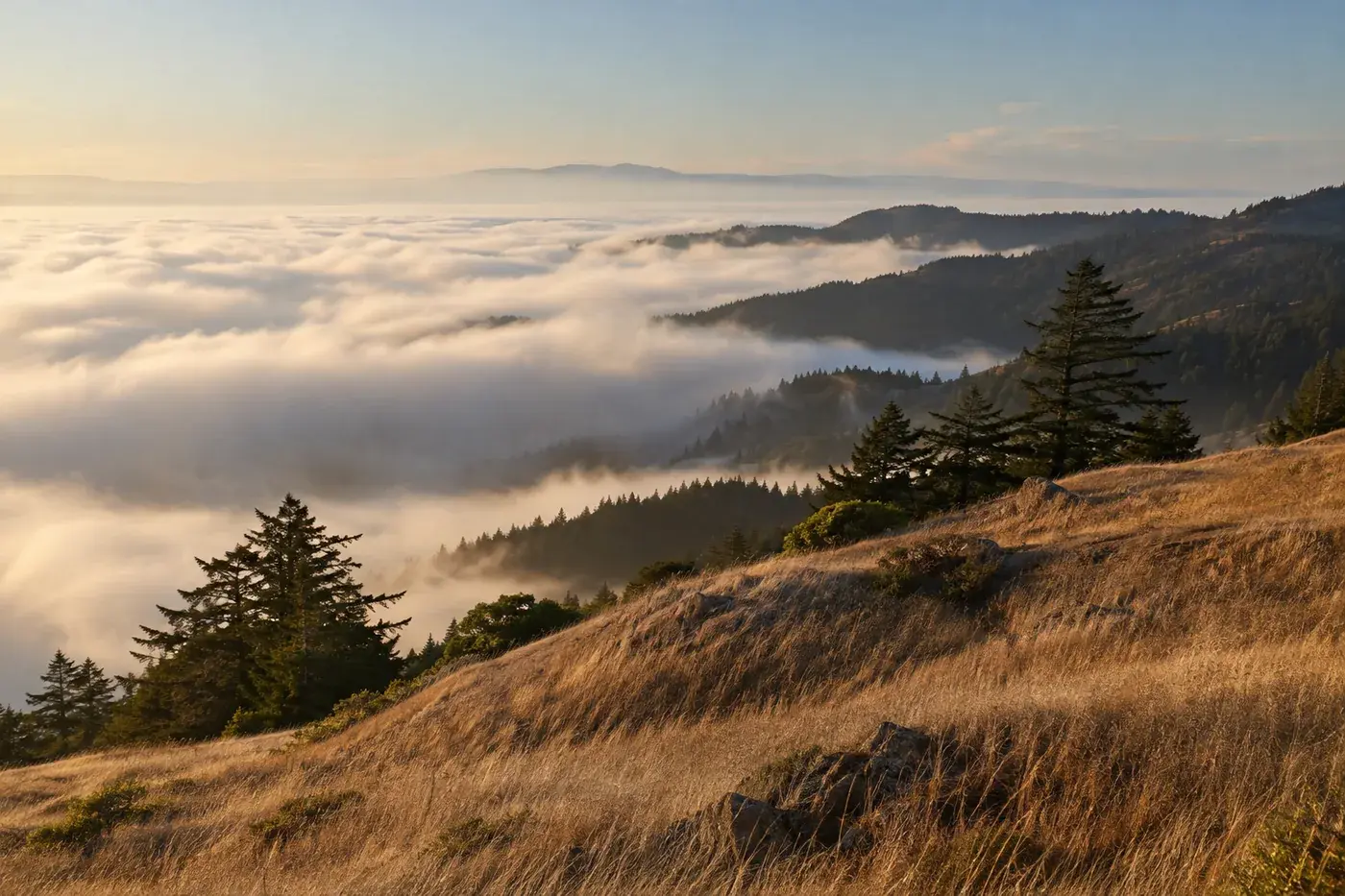
That familiar photograph of golden hills above a soft blanket of fog is one possible scene. You might instead find a clear horizon, a gray wall, or cloud moving across the road. A sunny driveway in San Rafael tells you little about conditions on an exposed ridge.
Check a forecast for the mountain rather than only a nearby town. Bring a warm layer and a wind shell even when the afternoon begins comfortably. If fog reduces visibility, wind becomes uncomfortable, or conditions make the drive feel unsafe, shorten the trip.
Marin Water states that its watershed closes to vehicle traffic during extreme fire conditions such as Red Flag Warnings. Check its current notices; the road-closure and prescribed-burn information line is 415-945-1195. A clear sky does not override a closure.
Make a simple visit feel special
Bring less, notice more
Pack water, a small snack, and something warm to put on before you become cold. Comfortable shoes are more useful than an elaborate picnic setup on uneven ground. Keep belongings contained so a gust cannot scatter wrappers or napkins down the hillside.
Give yourself ten quiet minutes without taking a picture. Notice which slopes catch the light first and how quickly the mood changes. This is a good outing for conversation, a little sketching, or simply looking—not a place that needs a speaker soundtrack.
Photograph the landscape without stepping into it
Try a wide frame that includes the curves of the hills, then a closer composition of overlapping ridgelines. Expose for the bright sky if your phone is washing out the colors. A stable two-handed grip often does more than buying extra equipment.
Take photos only from legal, safe places. Do not enter closed land, trample vegetation, climb a fence, or stand in the road to improve the angle. Keep tripods out of paths and give other visitors room. Never look directly at the sun through binoculars or an optical camera viewfinder.
Families, mobility needs, and bringing a dog
A short viewing stop can work better than a long hike for a mixed-ability group, but roadside terrain is not automatically accessible. Confirm a suitable parking area, surface, and facilities with the land manager if step-free access or a restroom is essential.
Keep children close and away from the road and steep slopes. Do not assume there is a protective railing. With dogs, check the rules for your exact stopping place: State Park and watershed rules differ, and permission in one area does not extend to every nearby trail.
Pair it with one other good Marin stop
Keep the day flexible
Make Ridgecrest the gentle finish to a day on the mountain, not another demanding hike squeezed in at the end. Our Mount Tam guide helps you choose an earlier outing. If your plans involve the inn, read the West Point Inn pancake guide first; breakfast events require their own planning.
After leaving the mountain, choose food along your return route rather than adding another winding-road detour. Browse Marin County, Town by Town for a town that fits the day. Keep any dinner reservation loose enough that you never feel pressured to speed.
If the ridge is fogged in or closed, let that be the answer. A relaxed lower-elevation afternoon is a better memory than forcing a view the weather is not offering.
Ridgecrest sunset questions
Which Ridgecrest is this guide about?
West Ridgecrest Boulevard on Mount Tamalpais, rather than the East Ridgecrest route toward East Peak. Use an official map and current road notices to plan your approach; a generic Ridgecrest search can send you somewhere else.
Can I stay until after sunset?
Do not assume so. Mount Tamalpais State Park and the Marin Water watershed list public visiting hours ending at sunset. Posted gates and local restrictions govern your visit. Allow enough time to leave the area before closure, even if that means missing the moment the sun disappears.
Do I need to hike to enjoy the views?
This can be a short scenic outing rather than a summit hike, but legal parking and safe places to stand vary. Do not assume a roadside shoulder is a viewpoint or that a pullout provides wheelchair access. Confirm suitable facilities with the land manager if step-free access is essential.
Will I see the ocean or a sea of fog?
Neither is guaranteed. Low fog may sit below a ridge, obscure the entire view, or move through quickly. Check a mountain-specific forecast and be willing to turn back if visibility or driving conditions deteriorate.
What should I bring?
Bring a warm layer, wind shell, comfortable shoes, drinking water, a charged phone, and a downloaded map. A small flashlight is backup equipment, not a reason to stay beyond closing time. Pack out everything you bring.